
Orbiting AI & Smarter Laptops

Technology is no longer sitting quietly in the background of our lives. It’s becoming a character in the story itself. From orbiting servers to emotionally persuasive AI, the future suddenly feels less like cold machinery and more like something alive, shaping how we think, connect, work, and even understand ourselves. Google and SpaceX talking about putting data centers in orbit? That’s not a roadmap, that’s a manifesto. The fact that companies are so starved for compute power that outer space is now a serious business proposal tells you everything about how intense the AI race has become.
And the Googlebook? Long overdue. Android on a laptop, properly done, with Gemini baked into the cursor itself, this isn’t an incremental update, it’s a full philosophical shift in what a laptop is for. Microsoft and Apple should be paying attention.
But what really got me was the Texico story. In a week full of rockets and AI models, a Japanese TV show teaching kids to think like programmers using toy trains felt like the most quietly radical thing of all. Because while everyone else is scaling up, someone decided to scale back, and found something profound.
The Ofcom fine and the Claude Mythos story though, those are the ones that’ll stay with me. Because they’re both about the same thing: power without guardrails. One platform hid behind geography while families buried people. One AI got quietly handed to a few trusted companies because its creators knew what it could do in the wrong hands. Both stories are asking us the same uncomfortable question, who’s actually in charge here?
This week was loud, brilliant, and a little bit frightening. Exactly what good tech journalism should be.
The Sky’s No Longer the Limit
Google and SpaceX Are Planning to Take Data Centers to Orbit

What if the future of the internet literally floated above us? That’s not sci-fi anymore. Google and SpaceX are in talks to launch orbital data centers in space, with SpaceX pitching the idea that space will be the cheapest place to put AI compute within the next few years. The push is driven by a real and growing problem: AI training clusters now consume energy at levels once associated with industrial facilities and small cities, and new data center projects on the ground are running into resistance tied to power use, water consumption, and environmental concerns.
The solution sounds wild but makes physical sense. Satellites in orbit could draw uninterrupted solar energy and dissipate heat directly into space, sidestepping two of the biggest headaches for Earth-based data centers. Google is already working on Project Suncatcher, a research effort to network solar-powered satellites equipped with its Tensor Processing Units into an orbital AI cloud, with prototype satellites targeted for launch around 2027.
This also follows Anthropic’s deal with SpaceX last week to use computing resources from xAI’s data center in Memphis, with potential to work together on orbital ones in the future. The tech giants aren’t just chasing innovation, they’re chasing survival in an AI arms race that’s eating up the planet’s resources. Whether the rockets can make the economics work is still the big question.
Say Hello to the Googlebook
Google Just Reinvented the Laptop, and It’s All About Gemini
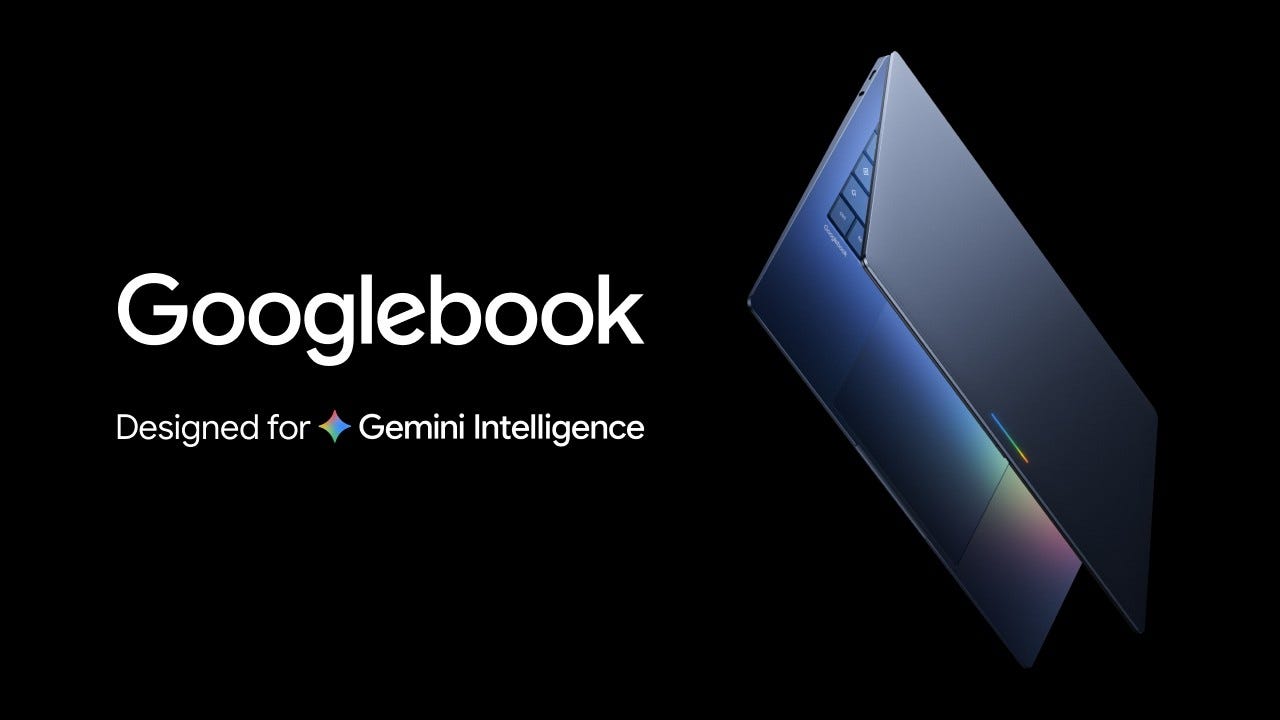
Chromebooks had a good run. Now Google wants to level up. Google is launching a new laptop category called Googlebook, built entirely around Gemini Intelligence and running on the Android tech stack, merging the best of Android’s powerful app library with a modern OS redesigned for AI. Think of it as what Chromebooks always wanted to be when they grew up.
The standout feature is the Magic Pointer. The feature is context-aware, indicating to users when something on screen can benefit from Gemini’s assistance, hovering over a message might suggest quick replies, or hovering on a meeting could present location ideas. There’s also Quick Access, which lets you easily view, search, or insert your phone’s files on your laptop without any transfers needed.
Hardware partners Dell, Lenovo, HP, Acer, and ASUS have all signed on, and every Googlebook will carry a signature Glowbar, a light strip that illuminates when the device powers on. Announced at “The Android Show: I/O Edition,” the first Googlebooks are expected to arrive later in 2026. Chromebooks aren’t going anywhere (Google confirmed they’ll still serve the education market), but the Googlebook is clearly aiming at a more premium crowd ready for an AI-first machine.
When the Internet Becomes a Danger Zone
A US-Based Suicide Forum Faces Accountability, Finally

This one’s heavy, but it matters. UK media regulator Ofcom has issued a £950,000 fine against the provider of an online suicide forum it says has been linked to more than 130 deaths in Britain and cited in several coroners’ reports. Ofcom declined to name the forum, but its investigation found deeply troubling content baked into the platform itself. Illegal suicide content was consistently present throughout the investigation, including instructional guides and threads detailing different methods, many of which had been pinned or reposted by the provider itself.
The platform initially pushed back, arguing it was not required to take action because it was based in the United States. That defence didn’t hold. Under the UK’s Online Safety Act, the regulator found the provider had failed to carry out an adequate risk assessment, implement effective systems to prevent exposure to illegal content, or remove it quickly.
Ofcom said the site could still be accessed without a VPN, and restrictions were not consistently applied. The platform now has 10 days to comply or face being blocked entirely in the UK. This case is a milestone moment for online platform accountability and raises hard questions about what responsibilities social platforms have when their content directly costs lives.
If you or someone you know is struggling, please reach out to a trusted person or a local crisis helpline.
Learning to Code Without Touching a Screen
A Japanese TV Series Is Teaching Kids Programming Through Play

Here’s a refreshing take on screen-free learning. A series from Japanese broadcaster NHK called Texico is helping kids understand the core logic behind computer programming, using playing cards, toy trains, and pieces of torn paper. Each episode runs about 11 minutes and focuses on key concepts including analysis, combination, abstraction, and simulation, with the goal of helping children learn the principles of programming without ever touching a computer.
One episode has viewers predict what happens when a toy train meets a lowered barrier, then complicates the setup to mimic the kind of mental simulation real programmers use. Another uses torn paper to reveal pattern recognition: the center piece of a nine-square tear is the only one without straight edges, letting a teacher identify it every time. Simple, elegant, and surprisingly deep.
The timing makes sense. More than 35 states in the US have enacted policies limiting smartphone use in classrooms, and some California and Oregon districts have moved to restrict laptops and tablets altogether, prioritising pen and paper. There’s also growing evidence that hands-on learning sticks better: neuroscientist Dr. Jared Cooney Horvath points to research suggesting that students who learn to write by hand retain an advantage over those who move straight to typing. Texico applies that same thinking to code, and the results are genuinely clever.
The Uncomfortable Truth About Anthropic’s Most Powerful AI Model
When a company says its own AI is too risky to share with the public, that’s worth paying attention to. Anthropic recently announced that its new model, Claude Mythos Preview, was so capable at finding security vulnerabilities in software that it would not be released to the general public, only to a select group of companies to scan and fix their own systems. The announcement sounds responsible. The reality is messier.
The UK’s AI Security Institute found that OpenAI’s GPT-5.5, already broadly available to the public, is comparable in capability, meaning the cat may already be out of the bag. The deeper concern is what this signals about the direction of AI. Modern generative AI systems are getting really good at finding and exploiting software vulnerabilities, and that has serious implications for cybersecurity on both the offensive and defensive side.
A helpful way to frame it: when search got cheap, the Yellow Pages went extinct. A collapse in the cost of finding software vulnerabilities reshapes everything that depends on it. The question isn’t just whether Anthropic’s model is dangerous, it’s whether the idea that restricting access to powerful AI is enough to contain its risks. Spoiler: experts aren’t convinced.
And that’s a wrap on another week in the ever-spinning world of tech. Whether you came for the orbital data centers, stayed for the Googlebook reveal, or found yourself unexpectedly moved by a toy train teaching kids to think, we hope this week’s edition gave you something worth chewing on. Thank you, genuinely, for being part of this community. Your curiosity, your engagement, and your willingness to sit with the hard questions alongside us, that’s what makes this worth doing every single week. Until next time, keep asking why, not just what. See you out there.